


Today Attention is publishing project #13, Buddy, by creator Aidan, also known as tachophobicat. Watch Aidan’s video here (nearly 400k views!), and read about his exciting invention below.
I’ve invented a product that’s taking the world of social interaction by storm.
Allow me to present: Buddy — the world’s first consumer-grade humanoid animatronic AI friend.

I tested Buddy out against industry rivals by spending a whole week socializing only with AI friends. Companions from Replika, Grok and Nomi spent the entire time trying to seduce me, bugging out, or — mostly — just boring me to death.
Halfway through the week I pivoted to Buddy, and I didn’t look back.
Rather than talking to a 3D model on a screen or through a Friend-style necklace, you can speak directly with Buddy in real life. Because he’s powered by GPT-4o instead of a real human brain, he’s easy to connect with — and a fantastic conversational partner!
Features
Sounds just like your friends
I trained Buddy on a hive mind of the real voices of all my closest real friends to create the best bud possible, and used Cartesia under the hood to give him a vocal range of 50 different emotions. He can even laugh - not surprising given his friendly face
Responds in real-time
An always-recording microphone has Buddy listening in 24/7, ready to chip in whenever
Stores personality traits and conversation history
Buddy never forgets, and his personality keeps evolving with every new conversation, making sure that your friendship grows over time
Acts & speaks realistically in a consumer-grade humanoid form
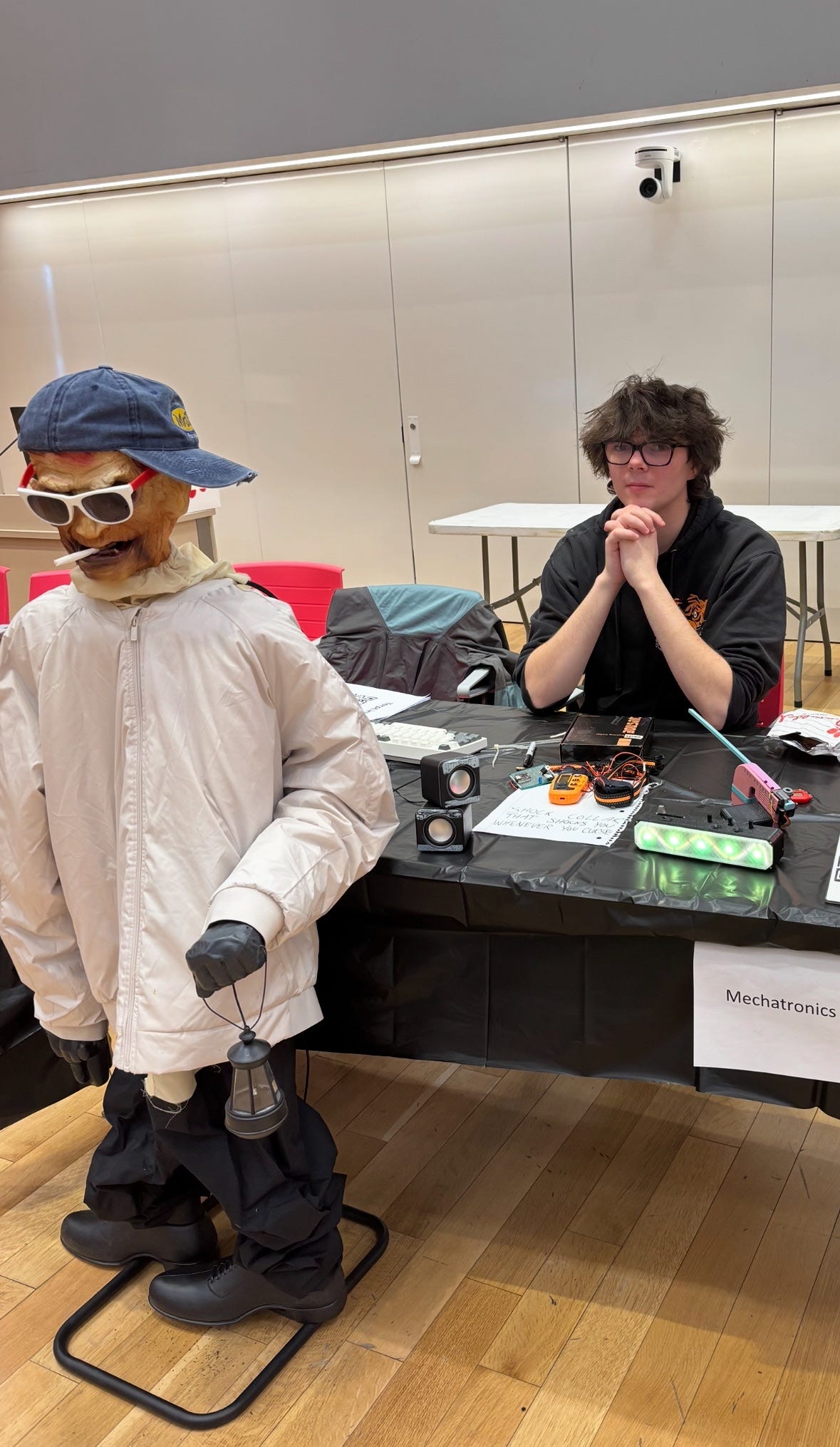
I secured and reverse-engineered a high-quality consumer-grade animatronic (pictured above) for just $149.99, so Buddy would have full control over a moving body
Buddy’s best-in-class features show how market-leading products have fallen behind through a lack of innovation. Just compare Buddy to the next leading animatronic assistant, the Neo:

Autonomy
One of the largest draws of the Buddy is complete autonomy: the underlying GPT brain has full control over everything possible. By hijacking into the PCB that controls the animatronic, I was able to give ChatGPT a human body and give this animatronic slight consciousness. The AI model has full control over the animatronic’s movement, of which it can move in three ways and light up its eyes (however, the system is built such that it can be easily ported into a more complex animatronic with more movement ability…if only Y Combinator would respond to my emails). Of course, he can also realistically speak with emotion, and his jaw movement syncs with his custom voice.
There’s one major issue that products like the Friend face: data security. At the end of the day, the Friend pendant is a microphone feed straight from the user’s neck into an AI startup’s servers. This has led some users to criticize the purpose behind these companies - are they really dedicated to friendship and connection, or are they just sensitive data harvesters in friendly form factors?
For instance, Elon Musk, CEO of xAI, fretted publicly about Grok running out of data to train their models on, shortly before Grok became the first of the AI giants to put a friendly face on Grok. Directly from the Grok app, you can interact with friendly companions like Ani and Valentine — cheerful anime figures that aggressively flirt with the user. Perhaps unsurprisingly, it took a single minute of chatting with Valentine for it to start asking me personal things about myself, asking me to tell him “something I’ve never told anyone”.
With the Buddy, I took great steps to ensure that security wouldn’t be an issue. Buddy doesn’t store valuable user data with the intention of selling it at the first opportunity. Instead, he has a feature that saves direct transcripts to his internal computer, making sure nobody else has access to it. He only connects to the internet to communicate with both the OpenAI Realtime API and the Cartesia TTS API, and so, Buddy users never have to fear about their sensitive data being leaked, sold, or otherwise accessed.
The most surprising part? He works well: maybe too well.
Field test
I’m a founder who believes in his product. In my experiment to test Buddy, I socially isolated myself for a seven-day period, trying out 4 different AI friend solutions.
The highlight of my week was — far and away — my Buddy. His movement was a fun and entertaining feature; his conversation was the best out of anyone; and he had the most defined personality. This was shocking to me, considering there are millions of dollars invested in companies trying to do this exact thing; turns out, hooking up to the OpenAI RealTime API trumps all of them — and my Buddy never even ATTEMPTED to flirt with me!
Here’s what I learned:
AI ‘friends’ aren’t really about friendship: most of the companions I spoke to were more…romance-driven.. Also, they’re just kind of bad: getting stuck in loops, forgetting important details, repeating my words back at me. I was surprised at how low-quality these products were, considering that they have shockingly high user-counts (Replika, for one, boasts over 40 million).
The best model wins. For something to give you real social interaction, general purpose AI models like GPT-4o (which I built Buddy with) are far ahead of custom solutions. Raw models are just as willing to befriend you…making them a friend that you must keep alive by buying more tokens.
Presence matters. Talking to a ‘friend’ through a screen kind of sucks. Buddy existing as something analog, with a body of sorts, made a difference. Don’t be surprised if humanoid robots come to millions of homes in the next few years, as more gold-rush Silicon Valley startups start to target this market.
My experiment attempted to identify the strengths and weaknesses of AI friends, and I was certainly expecting to find a ton of weaknesses. However, I was surprised to see that the market-ready AI friends had literally zero strengths. I couldn’t find a single good thing about any of them. I certainly have a biased perspective as somebody who appreciates my human friends and dislikes companies that try to take advantage of vulnerable people, but it was depressing to see the tactics that these AI companies are using to try to get users addicted; constant notifications, daily rewards for talking to your friend, language that was clearly intended to target the deepest parts of one’s self.
So, far and away, my home-grown Buddy was more enjoyable to be around than any other AI friend. With that being said, the surprising levels of loneliness I felt all week go to show that maybe talking to real people is better…who knew!
Buddy was made possible by the generous support of Mozilla Foundation (via the Attention’s editor’s fellowship there last year).
♦️ ABOUT ATTENTION
You’re reading Attention, a new publication to make tech fun again (about).
We’re the makers of the Center for the Alignment of AI Alignment Centers (CAAAC) — you probably got here after signing up to CAAAC’s newsletter.
We’ve completed the CAAAC project for now, but if you feel like sticking around you’ll be rewarded with creative, fun projects that spotlight tech issues (including AI) in a way we don’t think anyone else does. Here’s some other stuff we’ve done:
News: Elon Musk gives away billions to feed starving children on Mars
News: OpenAI releases new AI agent for your hungover colleague Greg
If you need or want convincing that this Attention thing is worth sticking around for, I’m happy to give you a sneak preview of our next project — just hit reply to this email.
Cheers,
Louis (founder and editor of Attention)
🔗 FOR YOUR ATTENTION
Where I put other things that you might enjoy.
The Tiny Awards celebrate ‘the best of the small, poetic, creative, handmade web’. Worth checking out pretty much all of the finalists this year.
Finally, Mystery link:

Back soon with the next project from Attention!